By Etienne Mainimo Mengnjo
The Acting Minister of Employment and Vocational Training, Mounouna Foutsou, has taken stock of the Secondary Education and Skills Development Project (SESDP) Training Vouchers, stating that youth empowerment and skills development remain at the core of government action.
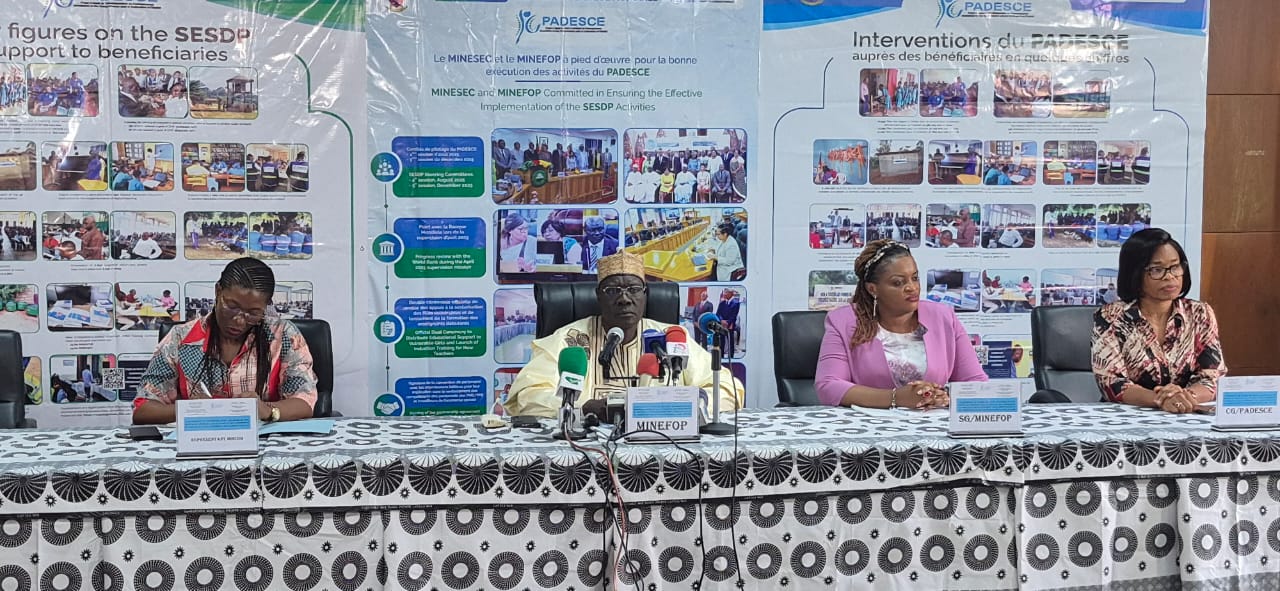
He made the declaration during a press conference on Thursday August 20 in Yaoundé. Reviewing the progress of the SESDP, Minister Foutsou emphasized that the training vouchers serve as a practical tool for democratizing access to skills-based vocational training across the country.
Expressing gratitude to the World Bank for its continued financial and technical support, the Minister highlighted key milestones achieved through the initiative. He noted that the vouchers comprehensively cover critical expenses, including tuition fees, insurance, personal protective equipment (PPE), basic personal tools, and certification assessment costs.
The call for applications was initially launched for 1,000 young people. However, 2,914 candidates were eventually selected from 7,783 shortlisted applicants, out of 11,221 formal submissions received.
Following the World Bank’s agreement to increase the number of beneficiaries, the program focused on three priority areas: 943 young people (including 314 women) in the digital sector; 1,400 young people (including 257 women) in heavy construction machinery operation; and 571 young people (including 58 women) in industrial welding.
“The selected youth will be trained at 10 private partner institutions, chosen based on an assessment of their technical capabilities, facilities, human resources, and the relevance of their training programs,” the Minister stated.
However, the Minister indicated that the SESDP program extends beyond initial training. During the first half of 2026, 5,843 workers—including 4,188 from the social economy and informal sector—benefited from continuing professional development.
“The training programs mainly focused on digital technology, construction, energy, and agribusiness,” the Minister said, adding that “they aim to maintain employability, support technological change, and improve productivity.”
As part of this initiative, 18 companies offered 646 apprenticeship positions and supported 244 supervisors across 53 trades, including metallurgy, automotive, construction, renewable energy, digital technology, agribusiness, hospitality, and safety environments.
“The solution to youth employment cannot rely solely on public sector recruitment,” he said. “It must simultaneously mobilize companies, entrepreneurship, and self-employment.”