By Etienne Mainimo Mengnjo
For many people entering the cloud computing industry, networking can feel like one of the most difficult parts of the journey. Cloud platforms such as AWS, Microsoft Azure and Google Cloud offer increasingly simplified interfaces, but beneath those dashboards remain the same networking principles that have powered enterprise computing for decades.
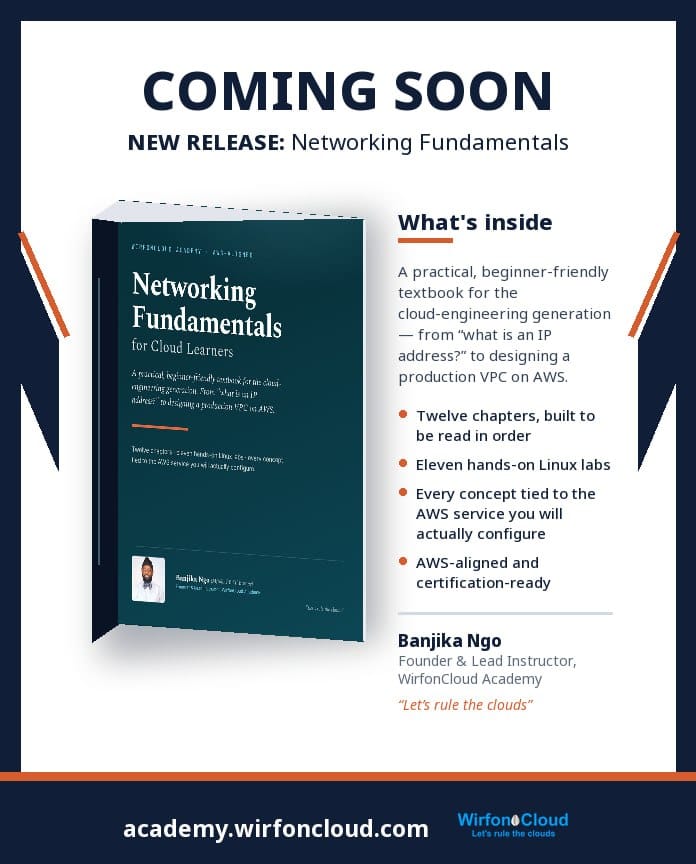
That experience is at the center of “Networking Fundamentals for Cloud Learners,” an upcoming book by Banjika Ngo (Mfòómé Bá’tí Europe), an AWS instructor and founder of WirfonCloud Academy, an African cloud and IT education platform serving learners across Africa and the diaspora.
Mfòómé says the book grew out of more than 15 years of professional experience in enterprise systems, infrastructure and cloud computing. His career began with traditional networking certifications, including the Cisco Certified Network Associate and Cisco Certified Network Professional qualifications, years before cloud computing became a mainstream career path.
“Years before I ever touched AWS, I sat for the CCNA. Then the CCNP,” Mfòómé said. “This was before ‘cloud’ was a career path anyone talked about. Networking was just the job — the thing that had to work before anything else could.” That background, he said, shaped his approach to teaching networking to people who are learning cloud technology today.
Mfòómé worked as a Linux administrator at Verizon GmbH in Germany before moving into enterprise cloud and infrastructure roles at IBM and Kyndryl. He said the examples in his new book are drawn from those professional experiences rather than being based solely on theoretical material.
At the heart of the book is a straightforward argument: Cloud computing depends on networking. “Every single cloud service you will ever build or manage — on AWS, Azure, Google Cloud, anywhere — sits on top of a network,” Mfòómé said. “Not ‘some services.’ All of them.”
Despite that dependence, Mfòómé believes networking is often given limited attention in cloud training. Students may learn how to create a virtual private cloud, configure a security group or deploy a server, but may not fully understand what is happening beneath the graphical interface.
He said that can create a particularly difficult problem for learners who have progressed beyond the beginner stage but still have unanswered questions about networking.
“Students memorise which console button provisions a VPC, pass a quiz, and still cannot explain why their own Security Group blocked their own traffic,” he said. “Not because networking is hard — because nobody explained what is actually happening underneath the dashboard.”
Mfòómé describes this knowledge gap as one of the reasons he decided to write the book. The project follows “Fundamentals of Linux for Cloud Learners,” the first book in his Foundation First series. He considers Linux an essential foundation for cloud computing because cloud servers rely heavily on operating-system concepts and administration skills.
“Networking is the floor underneath that floor — the thing that makes ‘cloud’ mean anything at all,” Mfòómé said. The new book is designed to connect familiar everyday experiences with technical concepts before moving learners into practical exercises. For example, an IP address is introduced through an analogy to a personal mobile phone number.
A router is compared with a post office that reads an envelope to determine where it should go without opening the letter. Network address translation, or NAT, is explained through the example of a hotel managing guests coming in and going out.
The concepts are then connected to Linux commands and, eventually, AWS services. Mfòómé said this approach is intended to help learners understand that cloud networking is not a completely separate discipline. “A subnet in a cloud VPC is not a ‘cloud version’ of a subnet,” he said. “It is the same idea, in a different building.”
The book contains 12 chapters and 11 hands-on labs. A central question runs through the material: What actually happens when a user types “google.com” into a browser?
By the final chapter, Mfòómé said, learners should be able to follow that process from the initial request through networking concepts and security mechanisms to the TLS certificate used to establish a secure connection.
The book is also designed for readers without previous networking or IT experience. Mfòómé points to the experience of Boris Mougoue, who began learning without a prior IT background and later became an application manager, as an example of the type of learner the material is intended to support. His story, along with those of six other learners, is featured on the WirfonCloud YouTube channel.
“Networking Fundamentals for Cloud Learners” is the second book in the Foundation First series. It is planned to be followed by “Python for Cloud Automation,” continuing the learning sequence Mfòómé describes as Linux, networking and Python.
The cover for the networking book has been completed, but the book had not yet been released at the time of writing. Mfòómé said it will eventually be paired with the Networking Fundamentals course offered through WirfonCloud Academy, following the model used for the Linux course and its accompanying book.
The project reflects Mfòómé’s broader effort to build cloud and IT education resources aimed at learners who may not have access to traditional technology training pathways.
To Mfòómé, the objective is not simply to help students pass certification exams. It is to give them enough understanding to diagnose problems and explain what is happening when cloud infrastructure does not behave as expected.
“If that sounds like where you’re starting from, you’re exactly who this book is for,” he said.
While the networking book is still forthcoming, “Fundamentals of Linux for Cloud Learners” is already available on Amazon, with PDF copies also available directly from Mfòómé. Learners interested in following the release of the new book can do so through WirfonCloud Academy and its educational channels.
The upcoming publication represents another step in Ngo’s Foundation First approach: building cloud skills from the underlying technologies upward, rather than beginning with the cloud dashboard and leaving the infrastructure beneath it unexplained.