By Brian Mboh
The National Blood Transfusion Service, NBTS, has called on the government to provide support and to introduce innovative financing mechanisms to boost the national blood bank, amid rising demand. The call was made by the President of the NBTS Management Committee, Prof. Tetanye Ekoe, during the 10th Ordinary Session of the Management Committee held on June 19 in Yaoundé.
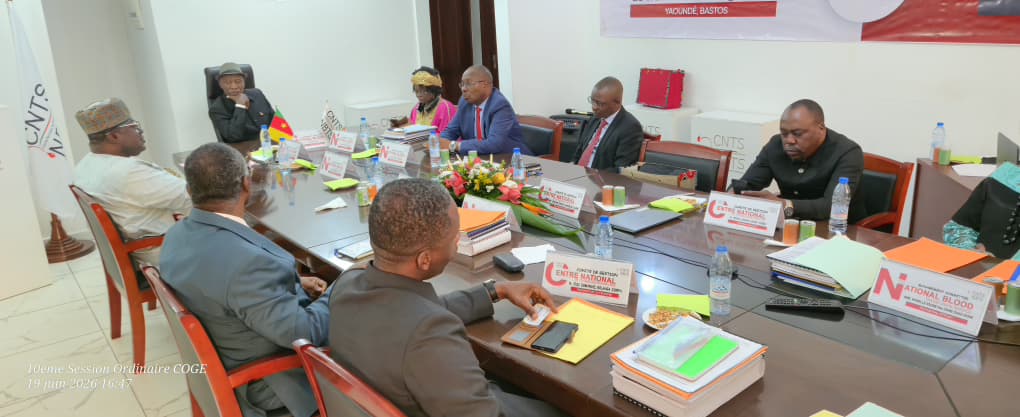
The Session reviewed the institution’s 2025 financial statements and assessed the mid-year implementation of the 2026 budget, which stands at FCFA 1.48 billion. Prof. Tetanye Ekoe said the National Transfusion Service continues to face major challenges linked to governance, financing, and public awareness—particularly the low rate of voluntary donations.
He warned that existing resources remain insufficient to ensure safe blood supplies across the national territory. Based on figures presented during the meeting, the NBTS collected 184,224 units of blood in 2025, raising national coverage of blood needs to 47 percent, up from 41 percent in 2024.
He regretted that the country still falls short of the estimated annual requirement of 400,000 blood bags. Prof. Tetanye Ekoe explained that the cost of collecting, testing, and securing blood supplies requires substantial financial resources. He said research conducted by medical experts shows that producing a single unit of blood costs about FCFA 60,000.
The health expert noted that meeting the country’s annual demand of 400,000 blood bags would require approximately FCFA 24 billion—far above the level of funding currently available to the institution.
“Mobilising the population, convincing people in both rural and urban areas to donate blood, and ensuring that the collected blood is safe all require funding. The resources currently available are not sufficient to cover these needs,” Prof. Ekoe said.
He also pointed out that the funding gap partly explains periodic shortages recorded in some hospital blood banks and the continued reliance on replacement donations from families instead of voluntary blood donations.

NBTS Raises Alarm on Need for More Funding
Prof. Tetanye Ekoe said the NBTS must intensify advocacy efforts with technical and financial authorities and seek new funding mechanisms capable of supporting its mission.
He said traditional financing methods are no longer sufficient to sustain blood collection campaigns, biological qualification of blood products, and staff training programmes.
“The mission assigned to us is to protect the population by providing safe blood in sufficient quantities. The financial mechanisms currently in place do not allow us to effectively carry out all our collection, qualification, and training responsibilities. We need stronger and more innovative sources of financing,” he said.

The NBTS reported that only 26.7 percent of blood donations currently come from voluntary, unpaid donors—a figure management said remains too low to guarantee stable national blood reserves.
Despite financial constraints, the NBTS said it has continued to strengthen coordination with hospital blood banks, expand technical supervision activities, and develop accreditation procedures for pilot blood banks involved in biological qualification.