By Etienne Mainimo Mengnjo
The government of Cameroon has mobilized partners to invest in youth empowerment, the key takeaway from a roundtable discussion held on August 11 in Yaoundé. The event was co-chaired by Paul Tasong, Minister Delegate to the Minister of Economy, Planning and Regional Development, in charge of Planning, alongside Mounouna Foutsou, Minister of Youth and Civic Education.
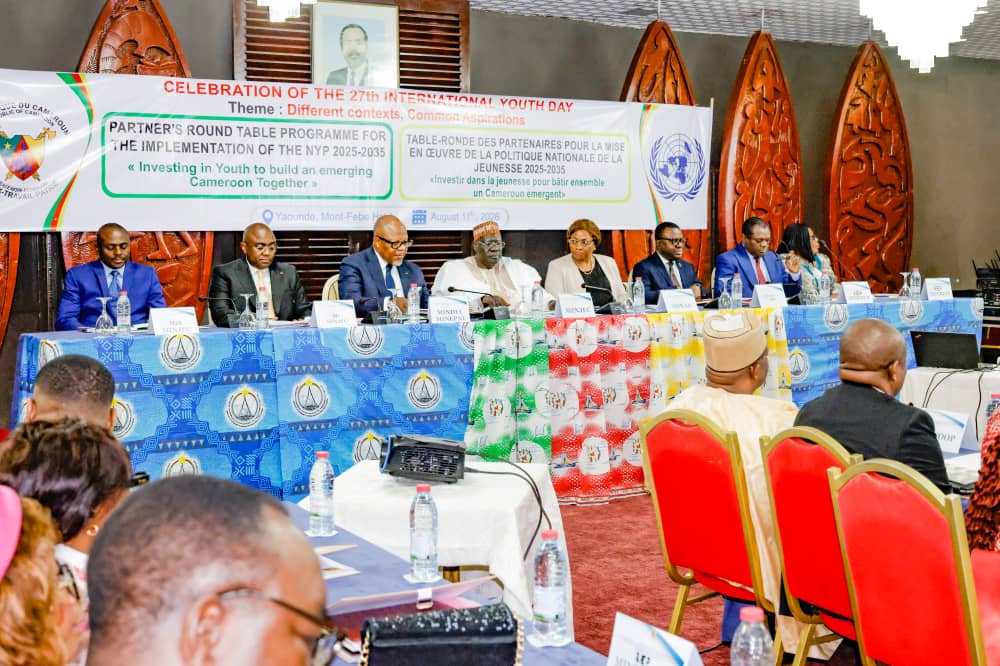
The Minister of Social Affairs, Pauline Irène Nguéné, as well as representatives from sectoral administrations, the United Nations system, technical and financial partners, the private sector, civil society, and youth organizations also attended the event.
According to officials, the objective of the meeting was to transition from vision to action through enhanced resource mobilization, coordinated interventions, and rigorous monitoring of commitments to youth.
Speaking during the event, Paul Tasong emphasized that young people should no longer be viewed merely as a demographic category, but rather as a driving force and determining factor for economic transformation, innovation, and social cohesion.
He underscored the importance of the “Youth Approach,” an institutional innovation that mandates the systematic integration of the youth dimension into the design, planning, budgeting, and evaluation of public policies.
This approach, he said, marks a shift from fragmented programs to an integrated, results-oriented public action plan designed to better coordinate interventions across government departments, local authorities, development partners, and the private sector to optimize available resources.
For his part, Minister Mounouna Foutsou called on partners to move beyond traditional project funding and instead forge structuring partnerships, secure additional financing, and establish sustainable cooperation mechanisms.
He highlighted that the relaunch of the Platform for Youth in Cameroon (PPJC)—conceived as a strategic dialogue and coordination framework between the State, financial partners, the private sector, and youth organizations—will strengthen coherence between national priorities and partner interventions while enhancing accountability.
Beyond establishing a framework for partner mobilization, the roundtable represents a critical milestone in implementing the National Youth Policy 2025-2035. The initiative aligns closely with the guidelines of the National Development Strategy 2020-2030 (NDS30), the United Nations’ 2030 Agenda, and the African Union’s Agenda 2063.