By Etienne Mainimo Mengnjo
For a few brief months, residents in Yaoundé felt they could finally breathe easy. The mountains of rotting refuse that had long defined the city’s streets had disappeared, replaced by a fragile—yet welcome—sense of cleanliness.
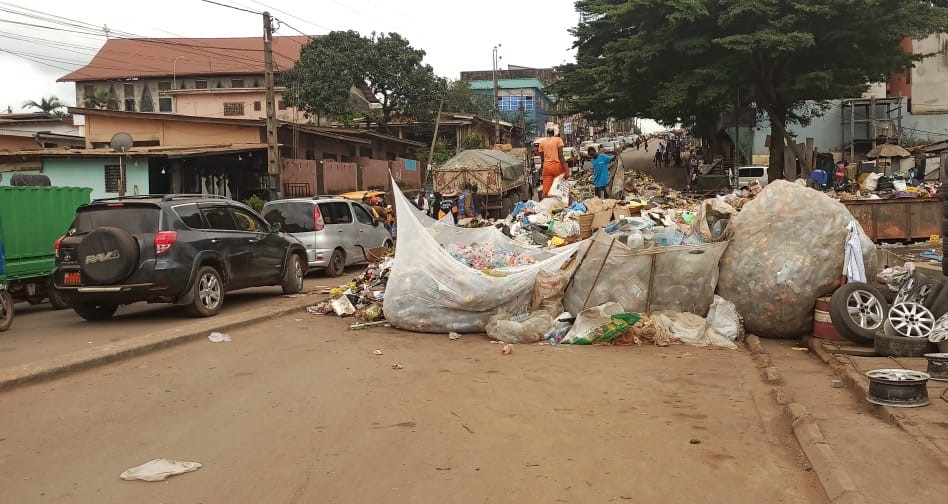
But that temporary relief has quickly faded. The garbage is back, and this time, it is reclaiming the city with renewed force. Today, particularly along the roads in the Yaoundé VI subdivision, the stench of decay is hard to miss. Heaps of household waste—plastic bottles, food scraps, and torn packaging—spill onto pavements and spill further onto the road. In some places, the problem has narrowed traffic to a single, hazardous lane.
For both pedestrians and motorists, daily commutes have become an ordeal—an unrelenting struggle between the need to move and the overwhelming instinct to step back from the foul odour that hangs in the air like a thick fog. The situation is especially alarming along the Tam-Tam Road, from Rond Point Express. What was once a relatively orderly stretch has deteriorated into an open-air dump. Residents appear to have abandoned any pretense of civic pride, using the roadside as an all-purpose disposal point for everyday refuse.
But this is not limited to one area. Across the capital, new dumping hotspots are emerging at an alarming pace—on street corners, in drainage ditches, and even beside signage erected by the Yaoundé Urban Council that prohibits dumping under threat of heavy fines. The warnings, printed prominently, have become little more than symbolic reminders as residents ignore them with impunity.
To many residents, the renewed wave of dirt is more than an eyesore. It represents a failure of governance and a breakdown in shared responsibility. The dominant mood is frustration—and growing calls for urgent action.
“I don’t know what to say anymore about waste management in this city,” Peter, a resident, told The Post, shaking his head in exhaustion. “The problem is never really solved. You think it’s gone, then the next week it returns worse. The government needs stronger policies and real enforcement, because what we have now is clearly not working.”
A young woman who asked not to be named said, “People don’t seem to understand how serious this is. They throw rubbish anywhere, anytime. We need to be more responsible—we need to keep our environment clean at all times. This is not just about beauty. It’s about our health. Diseases spread in this filth.”
Public health experts warn that the danger is real. Accumulated waste attracts rodents, flies, and mosquitoes—creating conditions that can fuel outbreaks of cholera, typhoid, and malaria, illnesses that often hit the urban poor hardest. Yet for many residents, the immediate challenge of navigating roads littered with rubbish is already severe enough to eclipse these broader concerns.
Mere Mary, a trader operating in affected neighbourhoods, described what she sees as a near-total institutional absence. “When I walk through Yaoundé VI and other areas, it makes me feel we are still far from finding a solution,” she said. “We don’t see council workers cleaning like they used to. The garbage trucks that came regularly have stopped showing up. The system is not clear—nothing seems to be working, and nobody is taking responsibility. Who is supposed to do what?”
Her question goes to the core of the crisis. Many observers argue that the problem is twofold: a failure of citizenship and a failure of the state. Residents, they say, must take back personal responsibility—stopping the casual habit of dumping waste into gutters and streets. At the same time, government bodies must carry out their duties, ensuring regular collection services, consistent enforcement, and a clear long-term strategy.
There are signs that authorities have not entirely ignored the issue. Official sources indicate that measures have been introduced to tackle the growing crisis, with additional steps reportedly underway. However, despite announcements and the distribution of waste management equipment to local councils, residents say the situation remains largely unchanged on the ground.
The stakes are high. Yaoundé is not just a city—it is the seat of national power and, according to many analysts, a symbol. Its cleanliness—or lack of it—reflects directly on governance and the government’s commitment to protecting citizens’ well-being. When the capital is overwhelmed by garbage, it sends a damaging message about priorities, competence, and the social contract.
As dusk settles over the Tam-Tam Road, refuse piles cast long shadows across the roadway. Children pick through the debris; motorbike taxis weave between mounds; and an acrid smell of burning plastic drifts from a nearby corner where someone is trying to reduce the waste by fire. This is the new normal—only it is not new at all. The months of cleanliness are fading into the past.
Fixing the crisis will require far more than temporary clean-up campaigns or fines alone. It demands a sustained, multi-pronged approach: dependable weekly collections, accessible public bins, aggressive public education, and a justice system willing to penalize repeat offenders.
Above all, it requires partnership—an unspoken agreement between the governed and those who govern. A clean city is not the work of one side. It must be a shared goal, supported by every citizen and every official.
Until that partnership becomes real, many residents fear the streets of Yaoundé—and other Cameroonian cities—will remain a battleground. Not between armies, but between laziness and ambition, between dirt and civility. And for now, the garbage is winning.