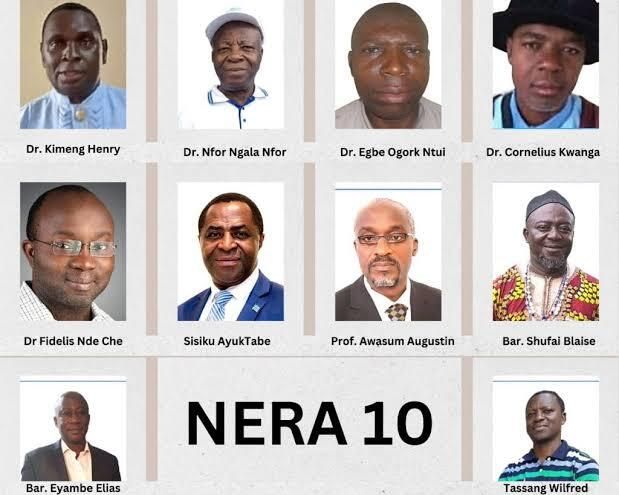
By Etienne Mainimo Mengnjo
The legal landscape in Cameroon shifted significantly on Thursday, March 19, when the Supreme Court intervened in the long-running case of ten prominent Anglophone separatist leaders.

The Supreme court overturned a previous ruling from September 17, 2020, which had originally upheld the life sentences handed down by the Yaounde Military Tribunal in 2019. This was the third hearing in the proceedings since the appeal was originally lodged on March 3, 2020.
This new verdict essentially resets the legal clock for the detainees, who have spent years in custody following their controversial arrest in 2018 in Nigeria’s Nera Hotel and subsequent extradition to Cameroon to face judgement.
The proceedings were remarkably brief, lasting less than five minutes. Justice Abomo Maire Louise, acting as the President of the Jury, delivered a judgment that did more than just cancel the previous decision; it rendered the entire prior Appeal Court process null and void.
The court determined that the matter must return to the Center Regional Court of Appeal for a completely fresh hearing. Crucially, the Supreme Court mandated that this new trial must be overseen by a different, legally constituted jury to ensure the procedural integrity that was previously lacking.
Legal analysts suggest that this referral back to the lower court highlights deep-seated procedural flaws and irregularities that have haunted the case since its beginning. Meanwhile, the defense team viewed the outcome as a major breakthrough, noting that the rights of the accused were likely compromised by a panel that was not properly formed.
Barrister Paddy Yong, the Lead Counsel for the defense, expressed a mix of triumph and caution regarding the path forward. He noted that while the decision is a win, he wished the Supreme court had taken a more direct approach to hearing the case.
“We hope they learn their lesson, because I think the better option would have been for the Supreme Court to hear the matter directly,” Barrister Paddy Yong said. He clarified that he was not blaming the court for choosing a different legal route, but pointed out that given the lengthy imprisonment of the accused, a direct hearing by the Supreme Court might have provided a faster path to justice.
Regarding the next steps, he explained that the timeline now rests with the lower court, stating, “Now, how soon the matter comes up in the Court of Appeal depends on the court itself. The Supreme Court has ruled, and once they type the judgment, they will send it back to the Court of Appeal. Then the Court of Appeal will issue summons, giving us a date to appear. So, it’s up to the Court of Appeal to activate the process.”
The unique nature of the ruling was also highlighted by Barrister Muna Akere, who observed that the Supreme Court took an independent path in its reasoning. He remarked, “The ruling has been given. The first thing which is remarkable is that the Supreme Court didn’t use any of the grounds raised by the counsel for the appellant. Rather, it brought up its own ground.”
To Barrister Akere, this suggests the court found fundamental legal errors that went beyond the specific arguments presented by the defense team.
Barrister Joseph Fru on his path pointed out that the United Nations Working Group on Arbitrary Detention had previously labeled the imprisonment of these leaders as illegal and unconscionable. He believes the Supreme Court’s decision validates those international criticisms.
He noted that “When the Supreme Court of Cameroon emphasizes that injustice, it shows that international jurisdictions have already seen something grossly wrong, and now the Supreme Court itself is acknowledging that something is wrong.” He further argued that the persistent procedural failures should ultimately lead to the release of the leaders, questioning who is left to solve the problem if the courts cannot get it right.
Barrister Roland Ashu described the annulment of a life sentence as an inherent victory, suggesting that the previous judgment lacked merit. He characterized the Supreme Court’s instruction to the lower court as a firm nudge toward proper judicial conduct.
“It’s like saying, ‘You know the proper way—write it down correctly and send it back.’ So, to an extent, this is a victory,” said.
For Sisiku Ayuk Tabe and his colleagues, who also faced massive financial penalties alongside their life terms, this ruling represents the first major crack in a legal wall that has stood for years.
Observers hold that the decision comes at a critical juncture in Cameroon’s Anglophone conflict, now in its ninth year, and could influence prospects for dialogue and peace in the English-speaking regions. However, the leaders remain in detention pending the rehearing.