By Etienne Mainimo Mengnjo
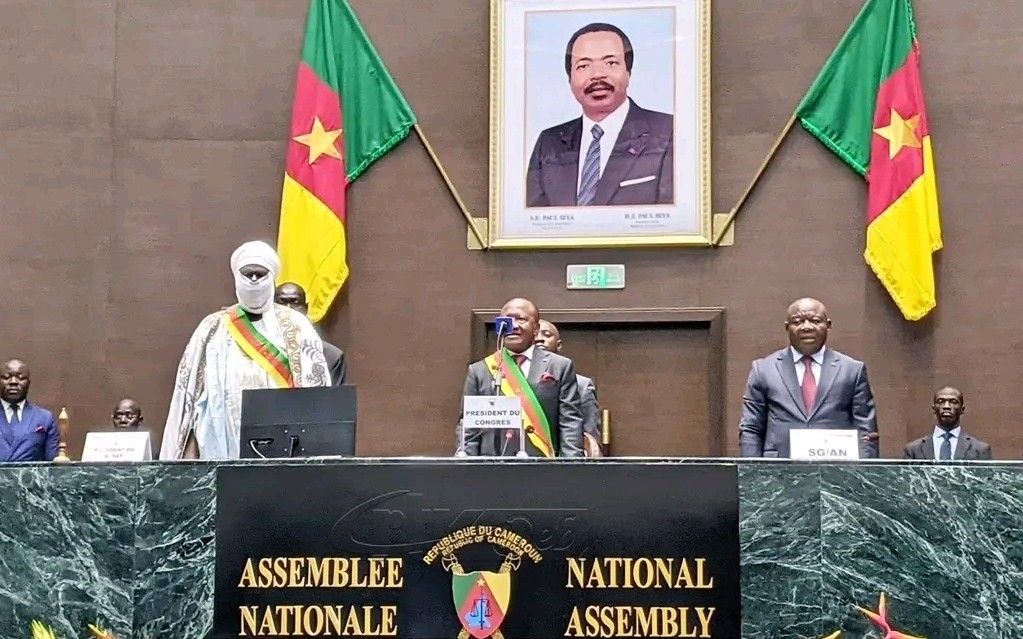
Lawmakers gathered on April 2 in a special Parliamentary Congress to review a bill that would re-establish the office of Vice President and significantly alter the line of succession in Cameroon.
The proposed Legislation (Bill No. 2094/PJL/P), which seeks to amend the June 2, 1972 Constitution revised in 1996 and 2008, follows a commitment made by President Paul Biya during his November 2025 inauguration. At that ceremony, the head of state pledged to modernize national institutions to better navigate contemporary challenges.
The Speaker of the National Assembly, Hon. Datouo Théodore, who acted as the President of the Congress presided over the joint session of the Upper and Lower Houses. He stressed that the initiative stems directly from the President’s constitutional authority to propose amendments.
Under the terms of the bill, the Vice President would be appointed and dismissed by the President, rather than being elected on a joint ticket. The primary role of the appointee would be to carry out specific duties delegated by the head of state. Furthermore, the Vice President’s tenure would be strictly linked to that of the President.
The most notable shift in the reform concerns what happens if the Presidency becomes vacant due to death, resignation, or permanent incapacity. Currently, the President of the Senate is first in line to lead on an interim basis. The new bill proposes that the Vice President would instead assume the office for the remainder of the term after taking an official oath.
Provisions remain in place for the Legislative branch to step in only if both the president and vice president are unable to serve. In such a scenario, the President of the Senate would act as interim leader and would be required to organize new elections within 20 to 120 days. This interim leader would face strict limitations, including a ban on running for the presidency or amending the constitution.
The reform would revise several articles of the constitution, which has not undergone a major overhaul since 2008. The President would maintain his status as the head of state and symbol of national unity, while the Vice President would be legally defined as an assistant. Both officials would be subject to identical rules regarding asset declaration and restrictions on holding other professional or elective offices.
During the session, Hon. Datouo Théodore described President Biya as the “principal architect of the democratic framework.” He noted that the changes are a necessary response to the country’s needs following the October 2025 Presidential Election.
The Speaker urged lawmakers to embrace the President’s call for national stability after a competitive election season. He quoted the head of state’s recent plea for cohesion: “The battles of the Presidential Election are behind us. Now is the time for unity.”
The reintroduction of the Vice Presidency marks a return to a structure not seen in the country for over five decades. The office originally existed following the 1961 reunification of East and West Cameroon to balance power between Francophone and Anglophone Cameroons. It was held by John Ngu Foncha and later Salomon Tandeng Muna before being abolished in 1972 when Cameroon transitioned to a unitary state.
For the bill to be enacted into law, it must receive an absolute majority of the votes from the members of Congress. If passed, the reform will also require subsequent updates to the national electoral code and the laws governing the Constitutional Council.